Product Overview
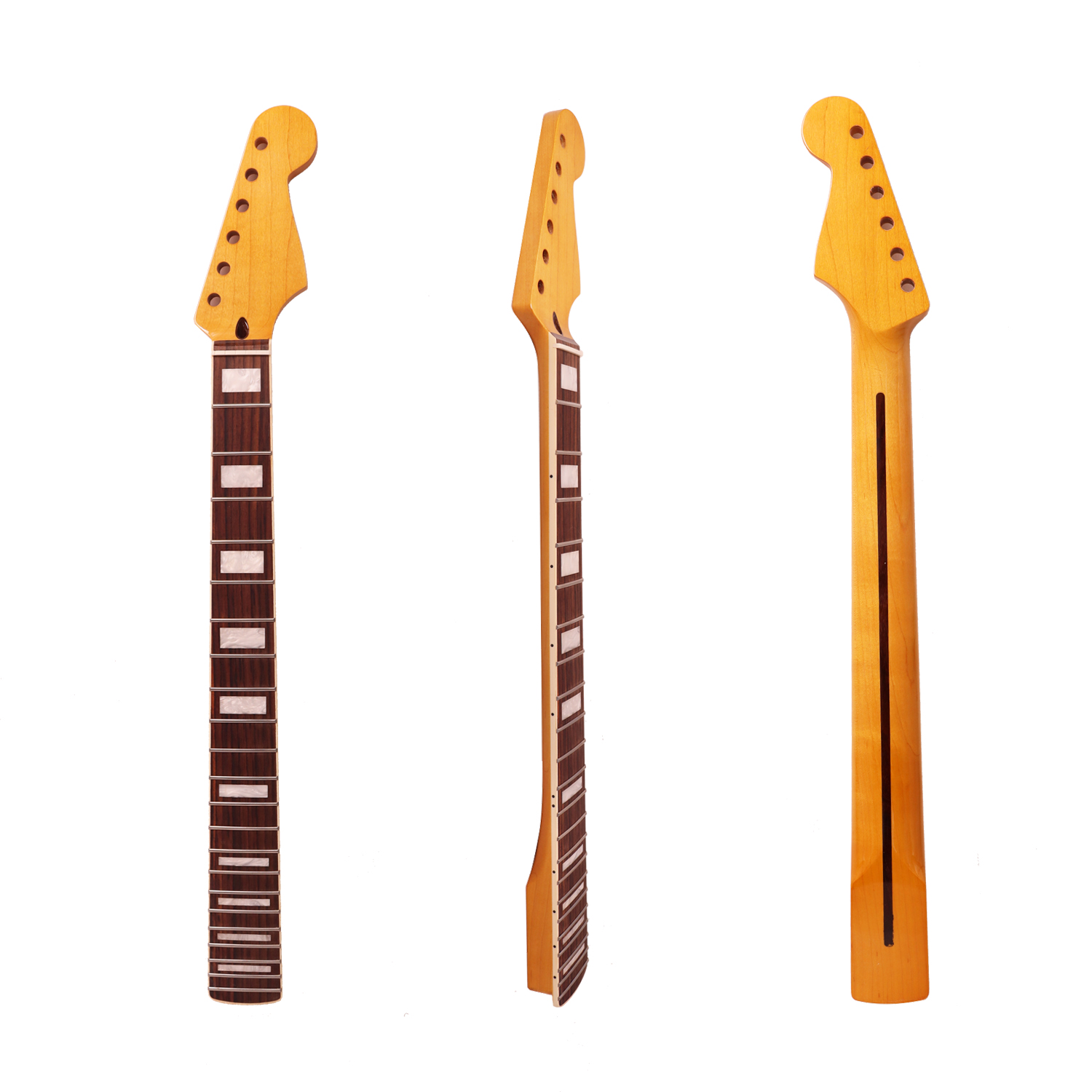
A replacement electric guitar neck for Stratocaster-style guitars: a hand-selected A-grade Canadian maple back, a rosewood board, 22 medium-jumbo nickel silver frets and a 25.5-inch scale. The vintage-tinted gloss and the white acrylic block inlays give it the look of a deluxe Strat build rather than a plain, dot-inlaid replacement.
It suits three kinds of work. A repair bench fits one when a customer's original neck is worn through the finish or has been broken at the headstock. A builder reaches for it when a partscaster needs a board that stands out on a rack. A player buys it when the guitar itself is fine and only the neck is not. If you have been after a rosewood guitar neck with a gloss finish instead of the usual satin, this is the version to pick.
What it is not: a complete guitar, an official Fender part, or a universal fit. Tuners, strings, body and hardware come from your own build, and whether it works for you is decided by measurements you can check before ordering.
Gloss Finish & Block Inlay
- Gloss with a vintage tint — the maple is finished in a warm amber-toned gloss that reads as an older, played-in instrument rather than a fresh pale blank, so a new build does not look new.
- White acrylic block inlays — rectangular blocks run the length of the board, and side dot markers sit on the edge so you can still find your position by feel under stage lights.
- A dressed-up alternative to plain markers — gloss and blocks are usually what separate a deluxe-style instrument from a standard one; here you get that look without ordering a one-off board.
- Gloss has a feel of its own — a finished, lacquered surface glides differently from satin. Some players like the extra grip of it; if you play long, sweaty sets or slide your thumb a lot, a satin back may suit you better, and we make that version too.
- A dressed-up look, not a novelty shape — the inlay and finish change the appearance; the neck still follows the guitar neck shapes Stratocaster players already know, so nothing feels unfamiliar in the hand.
- Easy to live with — wipe the back and board down with a dry microfibre after playing, and keep solvent polishes away from the inlays so the acrylic stays clear.
Maple Neck, Rosewood Fretboard
Maple and rosewood do different jobs on this rosewood guitar neck, and it uses both. The maple back is bright and quick, keeping the attack crisp and the low end tight, which is why so many Strat-style guitars are built on it. The rosewood board sits on top and takes the edge off, trimming some of the excess top end in the higher registers so the voice comes out rounder and warmer without turning muddy.
Rosewood is also why the board feels the way it does. It is played unfinished, so the surface stays smooth and slightly open under the fingers rather than slick. A maple guitar neck with a glossed board feels faster and glassier by comparison; this one feels warmer and a little more grippy, which most players notice within a few chords. The dark board against pale maple, with a rosewood skunk stripe down the back, is the classic vintage combination.
Expect natural variation in the grain and colour of each board. One piece may be darker or more evenly striped than the next, because that is the material rather than a finish fault. Keep the board clean and dry, oil it lightly only when it starts to look pale or dry, and leave the glossed back alone apart from a wipe-down.
Fretwork & Finishing
- Leveling — frets are the parts of a guitar neck your fingers meet first, so they are pressed in at intervals set by the scale length and then checked against one another until the tops sit level. Starting from a level neck is what makes a low action possible later.
- Crowning — each fret top is hand-polished and reshaped into its final rounded crown. This is the step that gives a clean note and a smooth transition as a string passes over the fret during a bend.
- Fret end beveling — the ends are rounded and brought flush with the edge of the board so nothing protrudes where the side of your hand runs up the neck.
- Edge and final check — the board edges are smoothed so they do not scratch the hand, then the whole neck is inspected on the bench before it is packed. Every neck we sell comes off the same luthier bench in our own workshop, which is how the fretwork stays consistent from one to the next.
- The result in the hand — a neck that plays fast along the board and stays comfortable when you are holding chords for an hour, with no sharp edge to catch you.
Truss Rod, Profile & Feel
- Dual action truss rod — it adjusts in both directions, so it corrects a neck that has bowed forward under string tension as well as one that has pulled back in dry weather. A single-action rod can only pull one way, which leaves a back-bowed neck with nothing left to give.
- Rosewood skunk stripe — the stripe on the back covers the rod channel. It is a working part of the neck, not decoration, and it sits flush with the maple.
- Modern C profile — a rounded shoulder that fills the palm without a hard ridge. Among the common guitar neck shapes it is the middle ground, comfortable for barre chords and still quick for bends.
- 12-inch radius — flatter than the 9.5-inch boards on vintage-spec Strats. Bends choke less as you push them, and chords still sit naturally; the board simply feels a little more modern under the fingers.
- Familiar guitar neck width — the electric guitar neck dimensions at the nut match what most Stratocaster players already have under their hand, so replacing a neck does not mean relearning the instrument.
- Maple back, stable under tension — a maple guitar neck holds its shape well under string load, which is why it has stayed the default on this style of guitar for decades.
- Adjusting it — work in small steps, a quarter turn at a time, and let the neck settle between turns. Check relief around the middle of the board rather than at the ends, and stop as soon as the buzzing clears.
Fitment & Installation
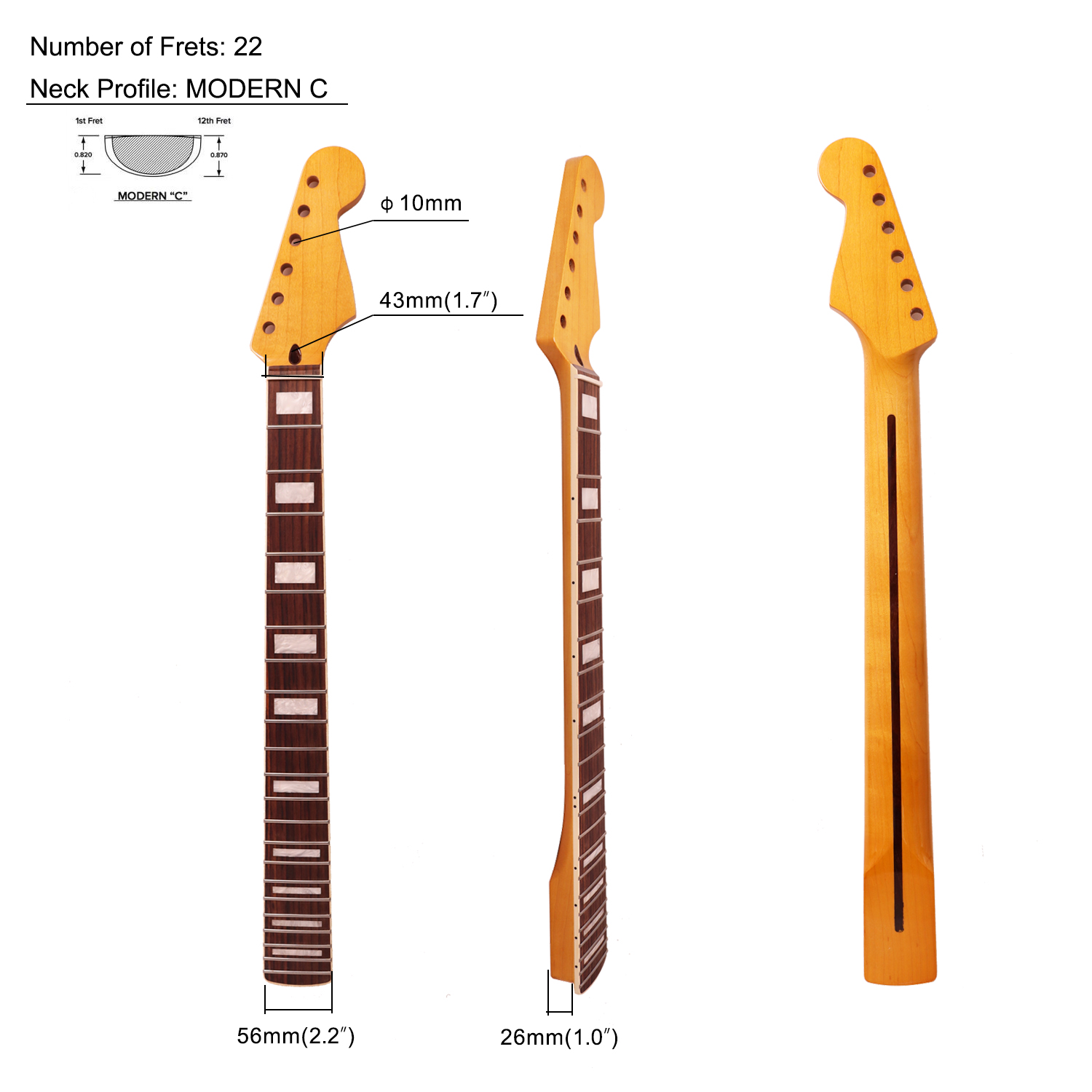
- Measure the pocket first — the electric guitar neck dimensions that decide most of this are the heel and the scale. Your pocket needs to take a heel 2.2 in wide by 1.0 in deep; if it is wider, the neck will shift, and if it is narrower it will not seat.
- Confirm the scale against the body — the electric guitar neck length is 25.5 in, so the body must be built for that scale. A 25.5-inch neck on a shorter-scale body will never intonate, however carefully you set it up.
- Match your tuners to the holes — the headstock is drilled to 10 mm. Compare that with the bushings or posts on the tuners you plan to fit before you order; a different size means bushings or reaming, not a different neck.
- Check the nut end against your preference — guitar neck width at the nut is 43 mm, the standard Stratocaster feel. If you normally play something much wider or narrower, this will feel like a change.
- Bolt it up — set the neck into the pocket, clamp it, and check that the strings run evenly down both edges of the board before any screws go in. Then fix it with the plate and screws your body uses and bring it up to pitch.
- Then set it up — tune to pitch, leave it a while, set relief with the truss rod, set action at the saddles, and check intonation at the 12th fret. That order matters: relief first, action second, intonation last.
Setup Notes After Shipping
Wood moves, and a neck that has spent a week in a box between climates can arrive slightly different from the way it left the bench. If one fret buzzes only when you set the action very low, or a note chokes on a bend, it is usually a single high spot rather than anything structural. Minor fret dressing or leveling may be necessary to compensate for environmental shifts during shipping, or to meet a specific low-action setup, and a technician can take it out with a few light passes of a leveling file and a polish.
Two things worth knowing. Shipping does not change the electric guitar neck length or the fret spacing; what shifts is relief, and occasionally one fret standing slightly proud. And give the neck a day or two at room temperature to settle before you judge the setup. At a normal action most necks need nothing at all; if you want the strings almost on the frets, budget for a quick dressing as part of the build. That is standard for any wooden neck, and it is not a fault in the parts of a guitar neck you received.
Specifications
| Specification | Detail |
|---|
| Product type | Stratocaster-compatible electric guitar neck |
| Neck wood | Hand-selected A-grade Canadian maple |
| Fretboard | Rosewood, with rosewood skunk stripe |
| Scale length | 25.5 in / 648 mm |
| Fretboard radius | 12 in / 305 mm |
| Frets | 22 medium-jumbo, rust-proof nickel silver |
| Inlays | White acrylic blocks, side dot markers |
| Nut | Bone, 43 mm (1.69 in) |
| Peg holes | Ø 10 mm, pre-drilled |
| Heel | 2.2 in (56 mm) wide x 1.0 in (26 mm) deep |
| Neck thickness | 0.82 in (21 mm) at the 1st fret, 0.87 in (22 mm) at the 12th |
| Neck profile | Modern C |
| Truss rod | Dual action |
| Finish | Gloss, vintage tint |
Neck Range Comparison
| Neck in the range | Finish and inlay | Fretboard and radius | Scale, frets and holes | Choose it when |
| This neck — Stratocaster gloss block inlay | Gloss with a vintage tint, white acrylic block inlays | Rosewood on hand-selected Canadian maple, 12 in | 25.5 in scale, 22 medium-jumbo frets, 10 mm peg holes, 43 mm nut | A repair or build where the guitar should look dressed up and you like the grip of a lacquered back and board |
| Satin Stratocaster neck | Satin | Rosewood on Canadian maple, 12 in | 25.5 in scale, 22 medium-jumbo frets, 10 mm peg holes, 43 mm nut | The same platform and tone with a bare-feeling back — the one for long, hot sets or players who dislike a lacquered feel |
| 24.75 in short-scale Stratocaster neck | Satin | Rosewood on Canadian maple, 12 in | 24.75 in scale, 22 medium-jumbo frets, 10 mm peg holes | Only when the body itself is built to 24.75 in scale; it is not a conversion neck and will not intonate on a 25.5 in body |
| Premium roasted flame maple Stratocaster neck | Satin | AAAAA roasted Canadian flame maple board, 9.5 in | 22 medium-jumbo frets, 10 mm peg holes | A high-end build where figured roasted maple earns the top tier, with a flatter 9.5 in board for heavy bending |
| Telecaster-style gloss block-inlay neck | Gloss with a vintage tint, white acrylic block inlays | Rosewood on Canadian maple, 12 in | 25.5 in scale, 22 medium-jumbo frets, 10 mm peg holes | A Telecaster-style body and pocket — the heel is made for that pattern, so the finish being the same does not make it a Stratocaster part |
| 4-string Jazz Bass neck | Satin | Rosewood on Canadian maple, or roasted maple board, 12 in | 34 in scale, 20 frets, 18 mm peg holes | A Jazz Bass replacement; bass scale and 18 mm holes mean nothing above will swap across |
| 4-string Precision Bass neck | Satin | Rosewood on Canadian maple, or roasted maple board, 12 in | 34 in scale, 21 frets, 18 mm peg holes, 1.65 in nut | A Precision Bass body, where the extra fret and the narrower 1.65 in nut are part of the fit |
Ordering & Delivery
- One piece is enough — minimum order is 1 piece. Order a single neck to check the look and the fit before you stock a shelf or commit to a build run.
- Lead time — ask us for the current lead time before you promise a customer a date. It varies with destination and with what is in stock at the time.
- Shipping — we ship internationally. Tell us the country and the service you need and we will confirm the method that suits the order.
- Packing — necks are packed to protect the board edges and fret ends in transit. If yours is travelling a long way or going into shop stock, say so when you order and we will pack it accordingly.
- Payment and terms — payment method and terms are confirmed at the time of order. If you are buying several necks for a shop or a run of builds, ask us about terms first.
Technical Support & Model Matching
Not sure whether a part will work with what you already have? Tell us what you are building or repairing, or send a few photos and measurements, and our team will help you confirm the match before you order. If something looks off after delivery, get in touch with pictures and details and we will help you find the cause and put it right. We can also walk you through fitting and first setup, step by step. Behind that is more than ten years of working experience, 100% quality control, and customer service that answers around the clock.
FAQ
Will this fit my Stratocaster-style body?
It is built to the standard Stratocaster platform: 25.5-inch scale, a heel measuring 2.2 in (56 mm) wide by 1.0 in (26 mm) deep, and 10 mm tuner holes. On a genuine 25.5-inch Stratocaster-spec body the electric guitar neck length and the pocket size should line up. 'Compatible' means made to those dimensions, not an official Fender part, so if the body is not a known standard, measure the pocket and the distance from pocket to bridge before ordering.
Which measurements should I check before ordering?
Four decide most of it: scale length, heel size, nut width and peg-hole diameter. The electric guitar neck dimensions here are a 25.5 in scale, a 2.2 x 1.0 in heel, a 43 mm nut and 10 mm holes. Guitar neck width at the nut is the one players notice most, because 43 mm is the familiar Stratocaster feel and a neck much wider or narrower changes the whole instrument. If one of those numbers does not match your instrument, this is the wrong part for that build, however good the finish looks.
How does the Modern C profile feel in the hand?
It is a rounded C with a gentle shoulder that fills the palm without a hard edge. Among the common guitar neck shapes it is the middle ground: not a hard V, and not a wide, flat shred profile. Most players coming from a modern Stratocaster will not notice a change, which is exactly what you want from a replacement neck.
Will the frets and nut be ready to play straight away?
The frets are leveled, crowned, polished and beveled before the neck leaves the bench, and the ends are dressed flush with the board, so there is nothing sharp to catch your hand. In most cases you can string up, set relief and action, and play. The parts of a guitar neck that may still need attention are the nut slots, if they need adjusting to your string gauge, and occasionally one fret after shipping.
Rosewood board on a maple neck — what does that do to the tone?
It balances the two. The maple back keeps the attack bright and the lows tight, while the rosewood board takes a little of the top end off the higher registers and leaves a warmer, rounder voice, with the smoother feel that comes from an unfinished board. Choose a rosewood guitar neck if you want warmth and a dark board against pale maple; choose a maple guitar neck if you want the brightest, snappiest version of the same guitar.
How is this different from your satin Stratocaster neck?
Same platform: 25.5-inch scale, 12-inch radius, 22 frets and 10 mm peg holes. Two things change. The finish is gloss with a vintage tint instead of satin, and the board carries white acrylic block inlays along its length. The gloss version is the one for a build where the look matters as much as the play; the satin version is the one for players who prefer a bare-feeling back.